

Bees in Folklore and Myth
Long ago and still today, many cultures believe that bees can travel to the Underworld and will deliver your message to a deceased loved one. If that loved one has a message for you, the bees will deliver that, too. Several years ago, I created a Samhain ritual around that belief. I’m exploring the idea again here, with a ritual that offers a way to connect with ancestors you don’t know. But first …
Family Bonds
Are you born to the bee? Or, as I’ve also heard it phrased, do you belong to the bee? Many years ago, if you kept bees you understood the bond you shared. Your role was to protect the hive from predators. The bees’ role was to pollinate your crops and make honey. Honey was, and still is, a valuable source of food and medicine for both bees and beekeepers.
At some point in your relationship with your bees you likely turned to them for solace. That’s because devoted bee keepers knew that the bees could safely travel to and from the Underworld, a powerful realm where the Ancestors “lived,” and it was from that realm deep in the earth that the Ancestors could protect the living. We see that belief today when a person swears on the grave of a loved one to tell the truth.
That understanding is why I see bees as the ideal spirit guides for Samhain (“SOW-en”), the Celtic fire festival that honors the Ancestors and marks the end of the growing half of the year.
Parts of Samhain have morphed into Halloween, a holiday we celebrate on October 31. Samhain, on the other hand, occurs when the Sun reaches the 15th degree of the sign of Scorpio. This year, 2026, Samhain will occur on the evening of November 7 (Eastern time).
Until a few months ago, a dear friend and her husband had kept bees for more than twenty years. His recent death and her own sudden and serious health challenges that followed toppled her world. I know the feeling of that particular free-fall. Most of the time, my friend’s energy is decidedly calm, her speech smooth, her movements reserved. But when I asked how she told the bees of her husband’s death, she dissolved in tears.
The age-old practice of telling the bees of a birth or a death in the family was, and still is, more than a custom. It shows the family’s respect for the bees and is key to a healthy relationship between members of the home and members of the hive.
I’ve heard it said that if the head of a family failed to inform the bees of a birth or death, the bees might abandon the hive. I don’t know if that’s true but I do know that in Medieval times stealing a family’s hive was a capital offense. I’ve also heard of an old Celtic custom that if you were stung by a bee and didn’t swat it in retaliation, the grateful beekeeper would owe you a meal of honey.
The Ritual: Born to the Bee
I think of ritual as a visible act performed with invisible intent. In the ritual Born to the Bee my intent is to connect on a spiritual level with certain loved ones who have died.
I start by creating an ancestor altar, or freshening an existing one. As you read the steps I take, please remember: There is no one right way. Follow your heart.
- Select a candle. Don’t worry if you can’t access a candle or you don’t have a safe place to light a flame. Draw a candle. As with all rituals, your intent is key and your mind is your most powerful tool. Why include a candle? Because the element of fire energizes our ability to name what it is we desire and to take action to achieve it.
- Include something from the world of the living. A flower, a leaf, a stalk of celery, a grape. You don’t have to get fancy. If winter has gripped your location, use a small potted plant, or a picture of one.
- Include something to represent the Underworld. Many cultures still bury their dead and mark the grave with a headstone. A stone from the land where you were born is ideal but these days that’s not an option. A stone from the land where you live now is a good option.
- Add something to represent your ancestors. Photos are an excellent option but we don’t all have such photos. We might not have names. We might not know where our ancestors came from. If that’s your situation, you can use any object to create a physical representation – a scrap of cloth for a weaver, a shell for a fisherman, a key for a member of the clergy. The choice is yours.
How you define an ancestor is also your choice. It can be a specific individual or a role you feel called to – a farmer, a healer, a warrior, an artist. You might envision a non-human. You might see your ancestor as a hawk or a dolphin!
An easy way to begin imaging an unknown ancestor is to think about places in the world you feel drawn to. I recently learned that I have at least one ancestor from Cornwall, England. I found a beautiful and very affordable collection of clipart on Etsy showing the coast of Cornwall.
- Add something to represent the bees. A jar of local honey, a piece of gold jewelry, a beeswax candle, or a yellow ribbon.
Sit by your imaginary hive, sip your tea, and tell the bees about the person who died. You may want to talk about someone who died recently, or someone who died decades ago. It’s up to you. Just don’t rush.
Then ask the bees one simple question: What would be helpful for me to know about [my loved one] or [my ancestor]? Be open to a cryptic answer. For instance, you might see a character in a movie and sense that whatever talent, adventure, hardship, or opportunity that character experiences could be part of your ancestor’s life story. Keep an open mind. As astrologer Caroline Casey says, “Believe nothing. Entertain possibility.”
The Buzz
Many people associate the appearance of a butterfly, a cardinal, or a dragonfly with a visit from a deceased loved one. Some people feel the same about hearing the buzz, or hum, of a bee. Science hasn’t found a way to prove these connections. Yet. Though buzz about the buzz is growing.
In fact, you can literally sleep with the bees at the Tavlebord Honey Farm on the island of Orust off the coast of southwest Sweden. Picture yourself climbing into one of several hexagonal chambers that are part of a large beehive…sort of. You and the bees are safely separated while you relax to the droning white-noise hum that is said to trigger deep, restorative sleep. That hum and the scent of honey and beeswax are all part of what is called “bee-bed therapy.”
Samhain and Ritual Recipes Podcast
The history, folklore, and magic of bees is one of several paths I’ve taken to create rituals for Samhain. Here are links to other Samhain rituals I talked about on my podcast Ritual Recipes.
- Episode 11, November 2018, Animals as Spirit Guides to help the community devastated by the mass shooting at the Tree of Life synagogue in the Squirrel Hill neighborhood of Pittsburgh, PA
- Episode 21, November 2019, Facing our Fears and the Threshold Energies of the Maiden, Mother, and Crone
For Your Consideration
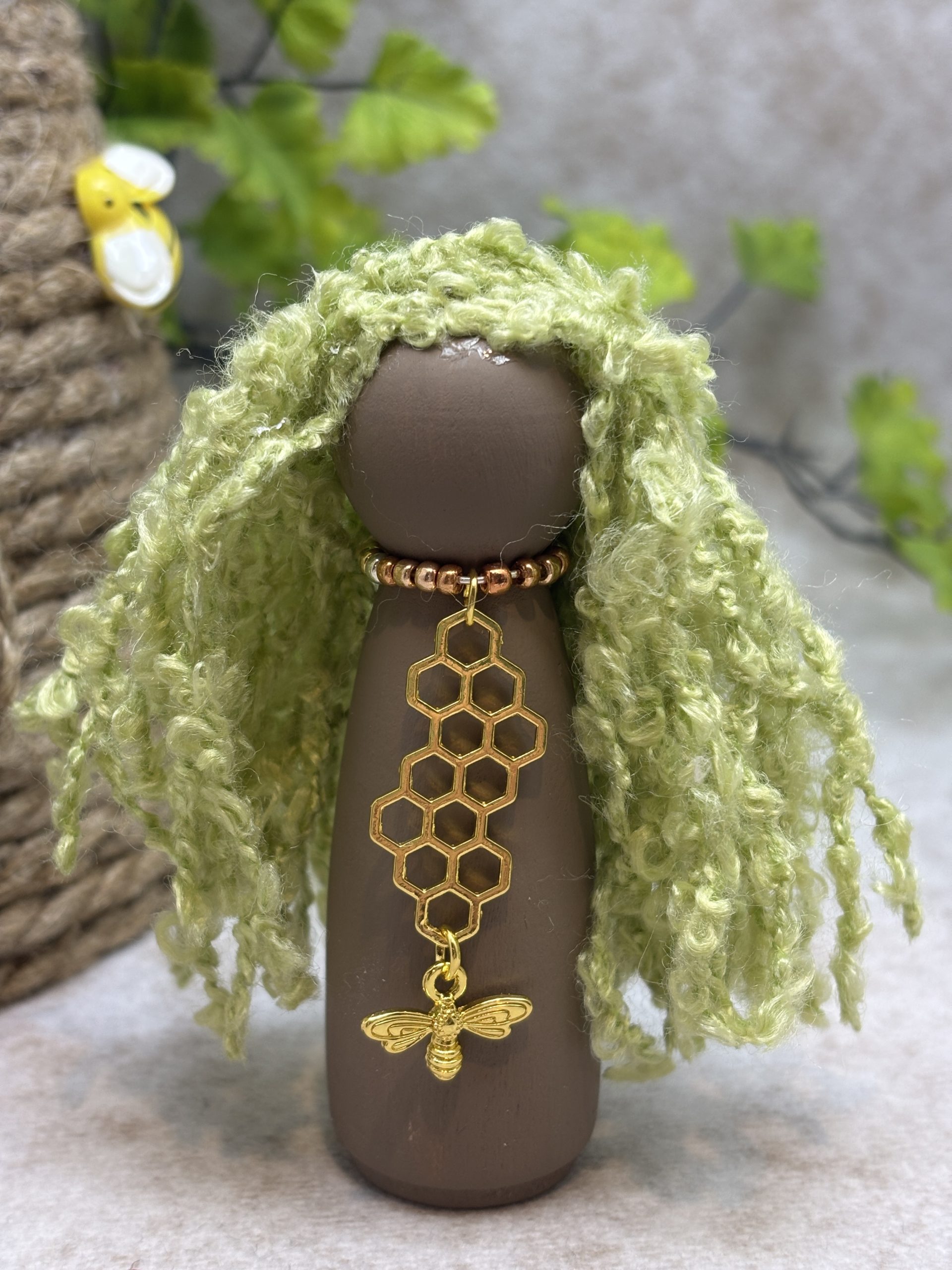 A Bee Priestess for your altar, 3″ high, wood, yarn, beads, honeycomb charm, hand-painted (by me) / $22 / Available on Moon River Rituals (my Etsy shop)
Leave a Reply