
In Part 1 of this article, I explored the connection between seashells and the Yemana, the Yoruba Orisha known as the Mother of All. I shared rituals inspired by cowrie shells, murex shells in general, and in particular, the Venus Comb Murex. With Yemaya in mind, I designed those rituals to help women discover and use their voice, and to value self-care – values important to Yemaya.
Here in Part 2, I harken back to a shameful time in our country’s history when the slave trade flourished and the powerful denied the rights of the powerless.
I’m white. I grew up in the 1950s and ‘60s in Virginia, near the Naval base where my dad served. The 13th amendment of our Constitution abolished slavery. That amendment was passed and ratified in 1965, 101 years before I graduated high school. The Civil Rights Movement created the canvas of my life in those years and has informed my thinking ever since.
I’m a few years shy of 80 now. For the last thirty years, I’ve created public and private rituals. Some have been to acknowledge rites of passage, especially weddings and funerals. I’ve created other rituals to celebrate the seasons and the cycles of nature. Still others for self-care.
In more recent years, I’ve been exploring Goddess mythology from around the world, looking for ways I can use ritual to bring their stories and gifts to my corner of the world. Why? Because I believe that the more we realize the ways we are all the same, the better chance we have of binding wounds and cultivating peace. Some of those stories are hard to hear. This is one of them.
The Middle Passage
Yemaya’s people, the Yoruba, originally came from the west coast of Africa in the areas of Nigeria, Benin and Togo. During the scourge of the Middle Passage, Yemaya’s people were kidnapped and brought to the Americas. With them, came Yemaya.
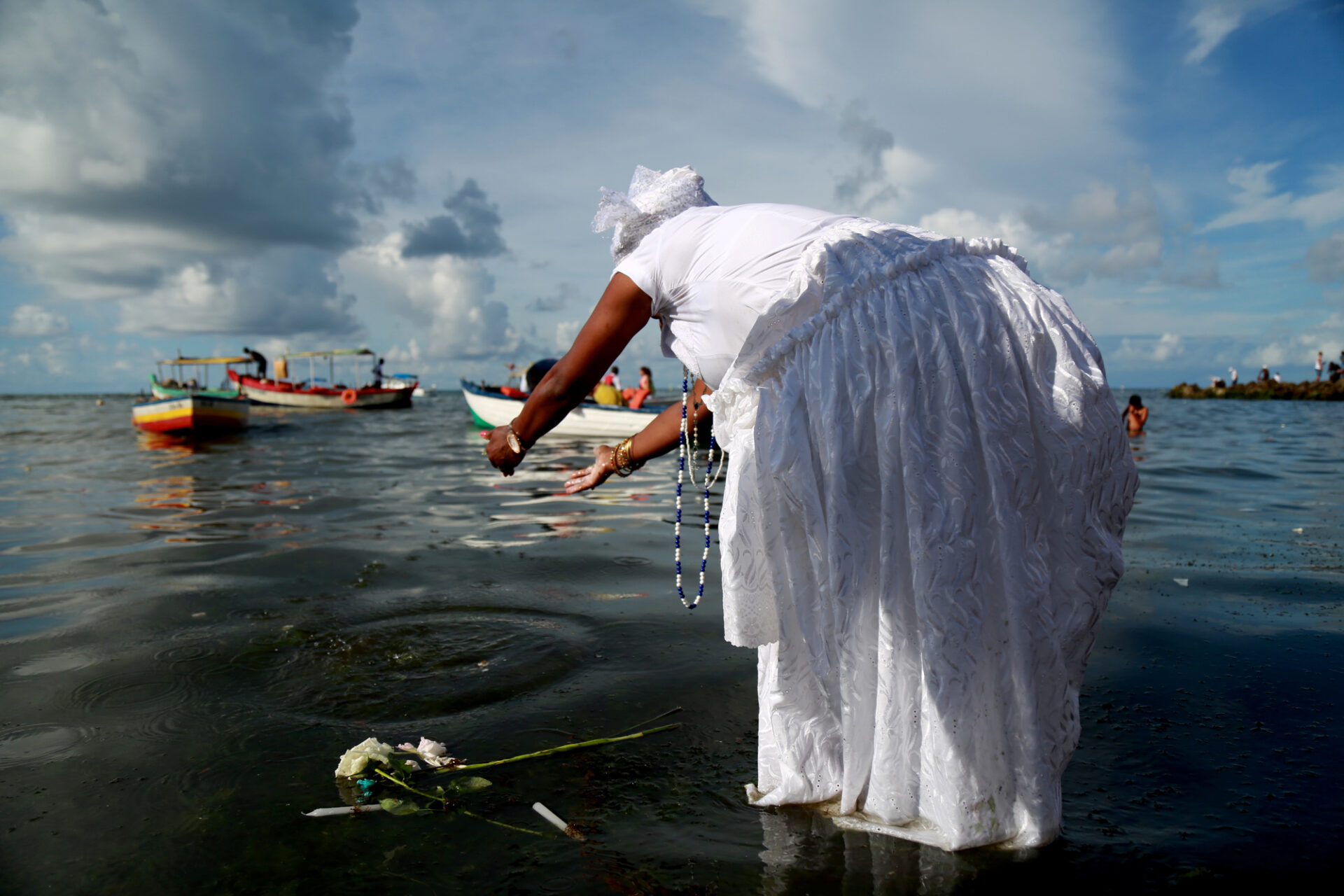
Artists often show Yemaya wearing full skirts with seven layers of blue and white — blue for the ocean’s water, white for the lacy foam on the waves. That’s not mere artistic license. Yemaya’s realm is the upper layer of the ocean. While that has always been important to the Yoruba, it had to have given immeasurable comfort to them and to other Africans who died crossing the Atlantic on The Middle Passage.
The name “Middle Passage” refers to the second part of a three-part journey made by cargo ships sailing from and to Europe. These voyages lasted for hundreds of years and are said to have begun on August 18, 1518. That’s when Charles 1, King of Spain, issued a charter authorizing the transportation of enslaved people directly from Africa to the Americas. The actions set in motion by that charter came to be known as the slave trade. It lasted into the mid-1800s – more than three hundred years.
The first passage was from Europe to the West Coast of Africa. A ship’s cargo hold would be full of iron, firearms, gunpowder and brandy.
When the ships reached Africa, the cargo was exchanged for human beings. Many of these men, women, and children had been kidnapped from the interior of Africa and kept in dungeons for a year or more, waiting for the ships to arrive.
Filled now with human cargo, the ships made the second leg of the journey, the “middle passage,” landing first in the West Indies, then in other parts of Latin America, and eventually into English colonies in North America. Each crossing took between 21 and 90 days.
In the Americas, the enslaved Africans — the human beings — were sold or exchanged for new cargo. Loaded now with tobacco and sugar, long timber, coffee and other items, the ships made the third leg of the journey and returned to Europe.
Millions of Africans were forced into the Middle Passage. It’s estimated that between ten and twenty percent of them died during the voyage, some to violence, some to injury, and some to disease. It was not uncommon for the captain to have those enslaved human beings thrown overboard, often chained together. So prevalent was the custom that sharks quickly learned to follow the slave ships.
Whatever horror you just imagined was, no doubt, eclipsed by reality.
If you can, imagine what went through the minds of the Africans still on board. Whether or not they saw other captives murdered, they had to have heard the screams.
Now, what if you believed with your whole heart and soul that the moment your loved ones fell into the blue water surrounded by white-laced waves…that they were instantly, safely, embraced in the strong and comforting arms of Yemaya, the Mother of All?
The Ocean Remembers
As I mentioned in the beginning, I believe the more we know about the mythologies of other countries, the more we realize we have in common and, therefore, the more likely we are to work together to cultivate peace. I’m telling you this particular story, this criminal, shameful time in history, for an additional reason.
The idea that the spirits of the dead haunt battlefields such as Gettysburg is not new. I think that’s because the land remembers what happened on it.
I also think the ocean remembers. As the world’s climate changes, as glacier ice melts and all the oceans rise, the stories of those sacrificed to the watery depths are rising, too. The story of the Africans who died during the Middle Passage — that story lives in the Atlantic Ocean.
Of course, there are no concrete borders to oceans. And we’re all familiar with the miniature ocean created in the womb as part of being pregnant. So I wonder … before being born, do we swim in an ocean containing a micro chapter of a larger story?
The spiritual aspect of this story is honored through Yemaya. The historical sweep is recorded through accounts of the Middle Passage. On the contemporary level, the story illuminates the history, preserves the pain, and can help us understand the depth of meaning in the words: Black Lives Matter.
Ritual: August 25, the Day of Healing
As mentioned above, the slave trade known as The Middle Passage is said to have begun on August 18, 1518. A hundred years later, on August 25, 1619, The White Lion landed in Jamestown, Virginia. It was the first slave ship to come to English colonies in America. August 25 has since been declared the “Day of Healing.”
If you plan to be on the water this August 18 to 25 — whether on a cruise ship with hundreds or in a kayak by yourself, or standing in the surf with friends, drop a white flower in the water. As you do:
- Acknowledge the pain and inhumanity of the slave trade.
- Thank Yemaya for the comfort she provided to the millions whose lives and legacies were lost or forever changed because of the Middle Passage.
- Vow to lend your voice to the truth that Black Lives Matter.
- Visualize a more just and compassionate world.
That last suggestion isn’t fluff. Thoughts precede decisions and actions. If we want a more just and compassionate world, we have to visualize it first. We have to imagine it, and imagine our role in making it happen.
Podcast Episode
Several years ago, I recorded an episode (#51) of Ritual Recipes that recounts much of what I’ve written here. I’m including the link here for your convenience.
August 25 – The Day of Healing
As I prepare to publish this post, August 25 is a month away. Consider using these next four weeks to gather with friends and perform the ritual described earlier. If onlookers ask what you’re doing, tell them.
My Purpose
We have to share what we’ve imagined. That’s why I wrote this article. As my dear friend and hospice chaplain, Victoria Burdick, once said, “Between now and dead, you’ve got a purpose. Don’t be timid.”
Leave a Reply